Eastern Thuringian Log Buildings
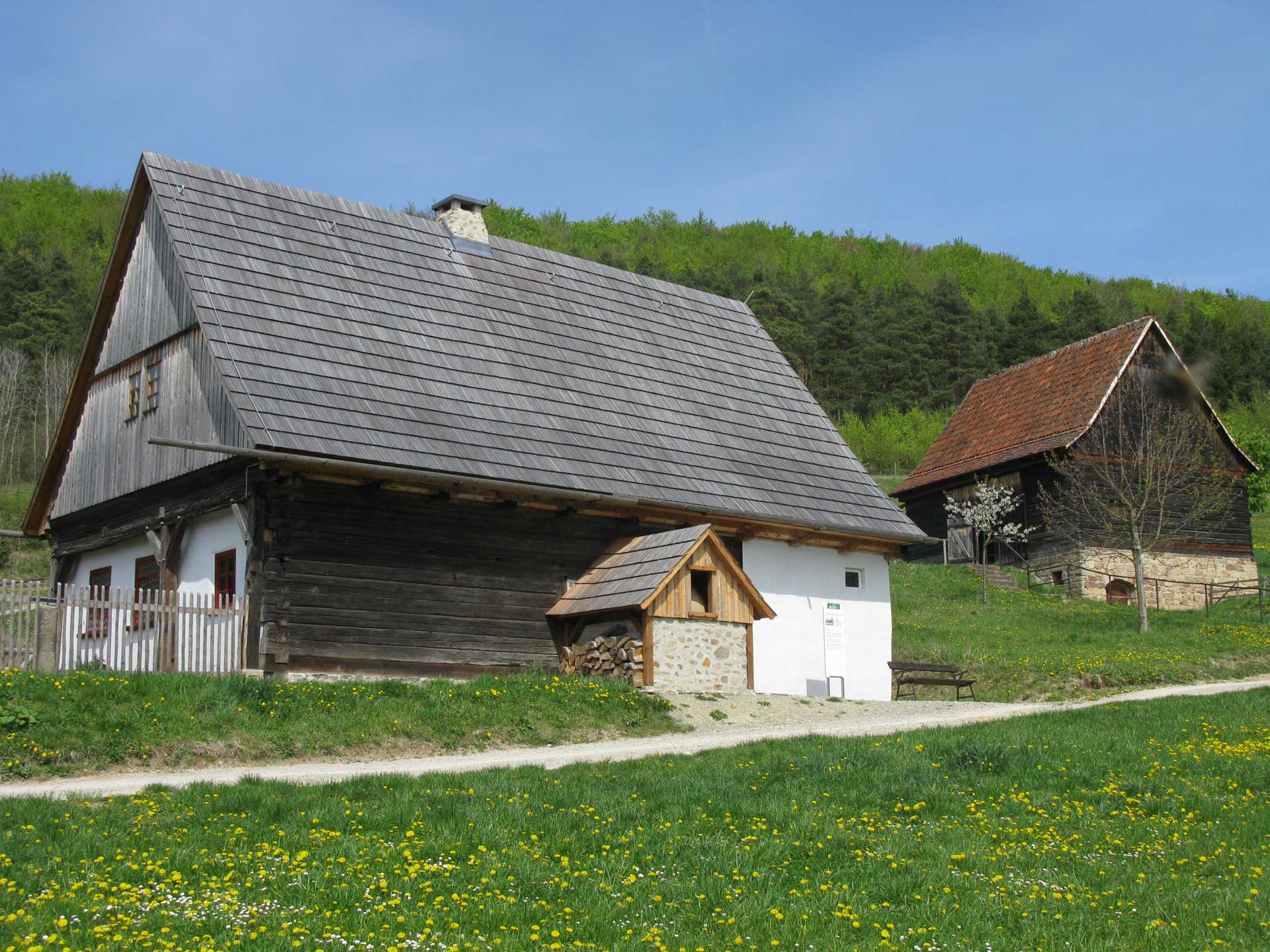
From eastern Thuringia come a half-timbered house with surrounding framework (Umgebindehaus) and a barn.
Both buildings were constructed using log construction. This method was widespread for centuries in forest-rich areas of Europe, including Thuringia. In some regions, such as today’s Saale-Orla district, the majority of village buildings were still log structures up until the mid-19th century. Today, only very few buildings of this kind remain in Thuringia.
For log construction, long, straight-growing coniferous trees (fir, spruce) were cut or hewn into beams with a square or rectangular cross-section. These were laid on top of each other and joined at the corners (notched). To prevent the beams from bulging out, they were additionally secured with wooden dowels (pins). In this way, not only houses but also stables, barns, and small outbuildings were built.
The Umgebindehaus Groschupp originally stood on the small river Wisenta between the villages of Langenbuch and Lössau near Schleiz (Saale-Orla district). An Umgebinde refers to a supporting framework built in front of log walls. Since this supporting structure in our house exists only on the gable end, it is referred to as a gable Umgebinde.
The house was built in 1685 by an arms and tool smith as a representative residence. It is constructed entirely of long coniferous beams. Only in the living room (Stube) were half-logs used: trunks split in half and stacked with the smooth side facing inward. In the central zone of the house lies the kitchen, built completely of fieldstones to reduce the risk of fire. In the museum, the house is presented as it looked at the beginning of the 19th century.
The barn, which stands behind the house, was originally built in 1696 in Stanau near Neustadt/Orla (Saale-Orla district) on a slope. The beams of the ground floor rest on a stone cellar. The barn has a threshing floor and two storage bays. Particularly striking is the elevated entrance, which allowed the farmer to drive into the upper floor with a cart.